


BC Game Hash and Player Trust
People search for bc game hash for a specific reason, and it is not because they want to learn cryptography. They want to know whether they can trust the results they are seeing on screen. Not the kind of trust that comes from a nice-looking website or a recognisable logo — the concrete, verifiable kind: “was this specific round actually determined before I placed my bet, or could someone have changed it after?” That is a much more precise question than most casino review sites bother to address, and it deserves a precise answer.
Why Hash Matters in Online Casino Trust
Hash is not magic and not a strategy tool. It is a mechanism for fixing data before revealing it, so anyone can check later whether the data changed. In a casino round, the hash locks in the outcome before your bet — like a sealed envelope with the answer inside, shown to you sealed, then opened after the round. For bc hash game formats like Crash, Dice, Limbo and Plinko, this matters because results happen in seconds with no dealer or physical mechanism to watch.
What Users Can Actually Verify
Expectations need calibrating. You can verify one thing: whether a specific round’s result matches the data committed before it started. You compare the server seed hash (pre-round) with the revealed seed (post-cycle), plus client seed and nonce. What you cannot verify through hash: the platform’s business model, whether house edge matches claims, payment integrity, licence compliance, or whether future rounds use the same system. Hash verification is a microscope for individual results, not an audit of the entire operation.
Trust Does Not Mean Guaranteed Wins
Bc game hash verification has nothing to do with your chances of winning. A provably fair result is often a losing result. The system proves the loss was determined honestly, not that you should have won. House edge exists regardless of hash verification, and fairness of process versus profitability for the player are entirely separate concepts.
What BC Game Hash Means
The concept explained without cryptography jargon, because understanding how hash works matters more than memorising a textbook definition. If you grasp the analogy, you grasp the system — the rest is just details about which exact mathematical function produces the output string.
Hash as a Digital Fingerprint
A hash is a fixed-length string generated from input data through a one-way function. Change one character and the output changes completely. Like a fingerprint: unique to its data, impossible to reverse, instantly different if altered. The platform generates a result, hashes it, shows you the hash before the round, then reveals the actual data afterward so you can reproduce the hash and confirm the match.
Why Hash Is Shown Before the Result
The timing creates the proof. The pre-round hash proves data was fixed before your bet. If the hash appeared after the result, the platform could generate a matching hash for any outcome. The sequence matters: commit first, bet second, reveal third, verify fourth. Hash game bc operates on this exact timing, and any system showing the hash only after the round provides no real verification.
Why Small Data Changes Matter
If someone altered the server seed by one bit after your bet, the resulting hash would be completely different from the pre-round commitment. This sensitivity is the system’s core strength — any tampering produces an obvious mismatch. No subtle manipulation passes a hash comparison undetected, because the function turns tiny input changes into wildly different outputs.
BC Game Provably Fair System
Provably fair ties the hash concept to actual gameplay through three components working together in a specific sequence. Each component serves a distinct purpose, and the system only works when all three are present and verifiable. Remove any one element and the verification falls apart.
What Provably Fair Means
The result of a game round can be independently verified after it ends, using data partially committed beforehand. The key word is “provably” — you check the evidence yourself rather than trusting a claim. Different from RNG certification, where you trust an auditor’s report. Bcgame hash gives you raw data to perform your own check on any round.
Server Seed, Client Seed and Nonce
Multiple data inputs work together in result generation, and each one serves a specific role. Understanding what each component does — and when it becomes visible to you — helps you make sense of the verification data when you encounter it in your bet history.
| Component | Created By | Purpose | When Revealed |
| Server seed | Platform | Primary input for result generation | After the active seed cycle ends |
| Server seed hash | Platform | Proves server seed was fixed before the round | Before each round |
| Client seed | Player/session | Adds player-side input to the calculation | Available during play |
| Nonce | System | Distinguishes individual rounds within a seed cycle | Available during play |
| Result | Calculation | The game outcome derived from all inputs | After each round |
The server seed carries the most weight in determining outcomes. It stays hidden until the seed cycle rotates. What you see before each round is its hash — proof the seed exists without revealing its value. After disclosure, you can verify every round played under that seed.
Hash Verification After the Round
Once the server seed is revealed, take it along with client seed and nonce, input them into a verifier, and compare against the game result. Match means the round was determined by committed data. Mismatch means either a copying error (check character by character) or a genuine discrepancy worth investigating.
How BC Game Builds Transparency with Hash Data
Transparency is a set of verifiable features that either exist in the platform’s interface or they do not. A banner saying “provably fair” means nothing without the actual data behind it. Here is what genuine transparency looks like in practice and what you should be checking.
Game History and Bet Details
You should find complete fairness data for each round in your bet history: server seed hash, revealed seed, client seed, nonce and result. If this data is not accessible or partially missing, the “provably fair” label carries less weight — verifiability without accessible data is just a marketing claim.
Open Verification Instead of Blind Trust
“Trust, but verify” — hash bc game online gives you the tool for exactly that. You check claims against cryptographic evidence rather than accepting words. Most players will never use verification, but the option existing changes the trust dynamic fundamentally.
Why Verification Should Be Available for Each Round
A player questioning a specific round needs data for that round — not a whitepaper about algorithms. Per-round verification separates genuinely provably fair systems from platforms that claim fairness without providing checkable data.
How to Verify BC Game Hash Results
These are the practical steps for checking whether a specific round was determined fairly. The process is not technically difficult — anyone who can copy and paste can do it. But precision matters enormously, because hash functions are extremely sensitive to exact input and one miscopied character produces a completely wrong result.
Step 1: Open Bet Details
Navigate to your bet history, find the specific round and look for a “Fairness” or “Verify” link. You need data for this one round — not a general fairness page. If no verification option appears, the game may not support per-round checking.
Step 2: Check Seed and Nonce Values
Copy values exactly — character by character: server seed hash, revealed server seed, client seed, nonce and game result. Do not enter your password, 2FA code or wallet keys into any verifier. These are never needed for hash verification — any tool requesting them is stealing credentials.
Step 3: Compare the Verified Result
Paste values into the platform’s verifier or independent calculator. If the recalculated result matches your bet history — verification passes. If not, double-check every copied value first. One wrong character changes the entire output. Only escalate after confirming accurate input — save screenshots and contact support.
What a Successful Hash Check Proves
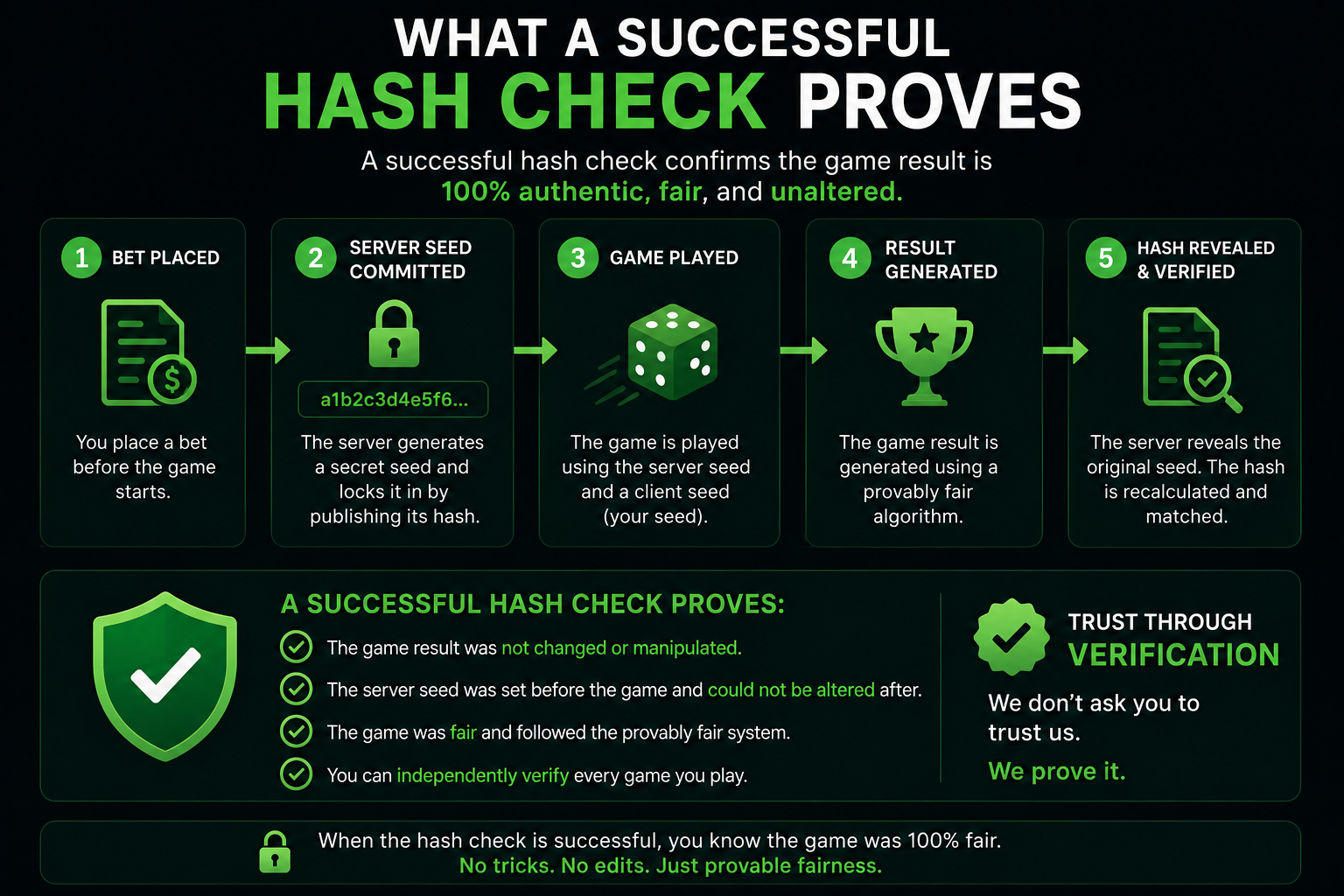
Understanding the boundaries of what verification tells you is just as important as knowing how to do it. A successful check answers one question and only one question — but it answers it definitively.
It Proves Result Consistency
A matching hash confirms that your result corresponds to the seed data committed before the round. The outcome was generated from declared inputs and not altered after your bet. This is the core guarantee: the result existed before the bet, and the hash proves it.
It Does Not Remove House Edge
Provably fair means transparent results, not favourable odds. The house edge remains unchanged whether you verify hashes or ignore them entirely. A fair coin flip is still 50/50 — proving fairness does not change the probability or put money in your pocket.
It Does Not Predict Future Rounds
Bc game hash game verification works backwards — checking completed rounds only. Anyone selling prediction tools is confused or scamming. The server seed for active rounds is hidden precisely to prevent prediction. If accessible, the entire provably fair system would be meaningless.
What Can Reduce Trust in a Hash System
Not all provably fair implementations are created equal. Some platforms display the label without providing accessible data, others have verification tools that produce inconsistent results, and a growing number of scam sites use the language of provably fair to lure technically-minded players into phishing traps. Knowing what reduces trust is just as important as knowing how verification works.
Missing Provably Fair Data
If you cannot find seed values or a verification section despite “provably fair” branding, the claim is unverifiable — defeating the entire purpose. A platform that uses the label without providing accessible data is asking you to trust a label, which is no different from any other unverifiable claim.
Verification Tool Does Not Match the Result
Re-copy all values and try again — typos cause most mismatches. If triple-checked data still does not match, save screenshots and contact support with specific round details. Do not continue playing until the discrepancy is resolved.
Third-Party Tools Asking for Login Data
A verifier needs game data only: seeds, nonces, results. Not your password, 2FA code, private keys or seed phrase. Any tool requesting these is harvesting credentials — targeting cautious users by impersonating a trust tool.
BC Game Hash vs Regular Casino Trust
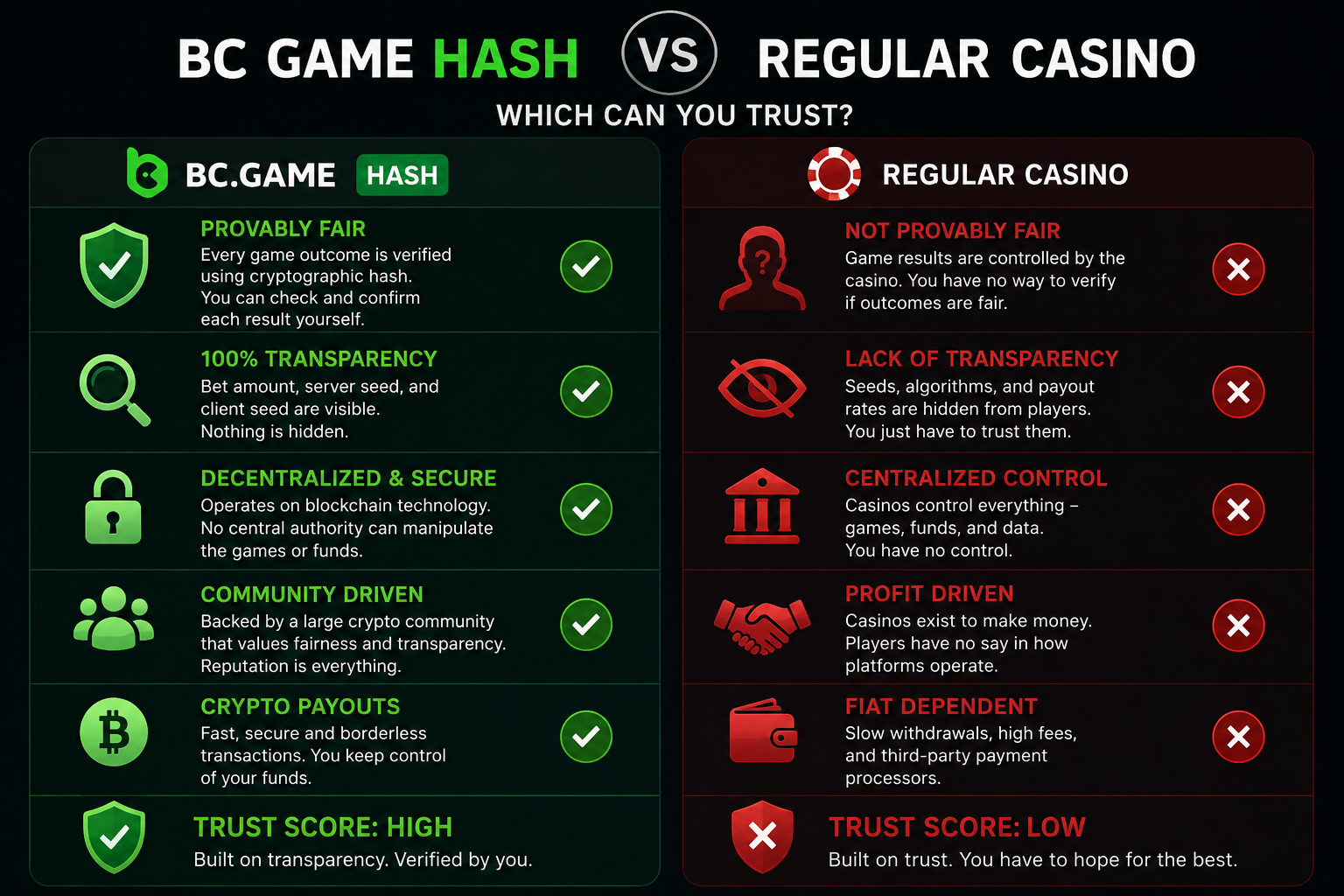
Hash verification and traditional trust signals address different aspects of the player-platform relationship. They complement each other rather than replacing one another, and a player who understands both has a much more complete picture of what trust actually means in online gambling.
| Trust Signal | Hash / Provably Fair | Traditional Casino Trust |
| What it checks | Individual round results | Operator compliance, game certification |
| How it works | Player verifies with seed/hash data | Third-party auditor certifies RNG |
| User involvement | Player can check directly | Player trusts the auditor’s report |
| Scope | Specific rounds in supported games | Entire game library (certified games) |
| Limits | Does not cover payments, licence, support | Does not let player verify individual rounds |
Hash Verification vs Casino License
A licence regulates who runs the casino. A hash verifies what happened in a specific round. Both matter for trust, but they answer different questions and neither substitutes for the other.
Hash Verification vs RNG Certification
In RNG-certified games, you trust a third-party auditor’s report but cannot verify individual rounds. In provably fair games, you test results directly. Neither is objectively superior — they serve different trust models.
Hash Verification vs User Reviews
Reviews reflect subjective experiences. Hash verification reflects objective data. A review saying “rigged” might be frustration; a failed hash check is concrete evidence. Different weight, different purpose — use both as complementary inputs.
BC Game Hash and Account Security
Even with perfect hash verification on every round you play, your account is only as secure as your login practices and digital hygiene. Provably fair protects the integrity of game results — it does nothing whatsoever to protect your account from phishing attacks, credential theft through fake verifier sites, or social engineering by people posing as support agents.
Fake Hash Verifier Sites
Some “verification tools” are phishing pages with professional interfaces that include login fields alongside seed inputs. Legitimate verifiers never need credentials. If a site asks you to log in to verify results — close it immediately.
Mirror and Phishing Risks
Logging into an unverified mirror to check hash data might mean entering your password on a fake page. Hash verification does not protect against phishing — that is an account security issue on a different layer entirely.
Protecting Your Account Before Verification
Before checking hashes, secure the basics: strong unique password, 2FA enabled, verified official domain, no credentials shared with anyone. These measures protect your account in ways hash verification cannot.
BC Game Hash Myths and Scams
The provably fair space has its own ecosystem of misinformation and scams, and they target the exact audience that cares about verification — which makes them particularly effective against well-intentioned players trying to be careful.
Hash Predictor Claims
“Know the next result before it happens” — the most common provably fair scam. The server seed is hidden and mathematically impossible to derive from the hash. No tool can reveal it. Hash bc game prediction tools are either useless fakes or credential-stealing malware. The premise contradicts the mathematical properties that make hash functions work.
Crash Hack and Guaranteed Multiplier
“Guaranteed 10x,” “crash hack,” “sure signal bot” — scams targeting players who do not understand hash-based result generation. The crash point is determined by a hidden server seed. No client tool can access it or alter the calculation. The result is set before the round and revealed after — no tool changes that.
Mod APK With Hash Advantage
A mod APK cannot give hash advantage — results are calculated server-side, not on your device. What it can do: steal credentials, install keyloggers, access wallet data. The claimed upside does not exist. The real downside — account theft and malware — very much does.
How BC Game Hash Affects Player Confidence
Beyond the technical mechanics, the hash system changes the psychological relationship between player and platform. When you can verify results independently, the dynamic shifts from blind faith to informed participation. This affects not only how you evaluate individual rounds but how you think about risk, casino marketing claims and your own decision-making patterns over time.
More Control Over Verification
Provably fair lets you check the casino’s work — no auditor needed. You verify results using the same function that generated them. For crypto-native players, this resonates: the ethos of cryptocurrency is trustless verification, and provably fair applies the same principle to gambling.
Less Dependence on Casino Claims
With verification data accessible, marketing claims carry less weight. “We are the fairest casino” is an unverifiable boast. “Here are your seed values — check yourself” is a fundamentally different proposition. The shift from “trust us” to “verify us” changes the dynamic regardless of how many players actually verify.
Better Understanding of Risk
Understanding hash plus house edge helps avoid two traps: thinking provably fair means profitable, and thinking a losing streak means rigged. Neither is correct. A player who understands that a verified fair result can still be a loss has a healthier relationship with gambling.
When Hash Verification Is Useful
Most players will never verify a single round, and that is perfectly fine — the system works as a trust signal even when unused, because the option exists. But there are specific situations where checking the hash data becomes genuinely valuable: after a result that feels wrong, during a losing streak that makes you question the system, or when trying a new game format before committing serious money. In those moments, verification transforms speculation into evidence.
After an Unexpected Result
Crash at 1.01x right after a large bet? Before assuming manipulation, check the hash. Verification tells you whether the result matched committed seeds — more useful than frustration. Most unexpected results turn out consistent with provably fair data. The “unexpected” part is just variance.
After a Losing Streak
Ten losses in a row feels like it cannot be random — but with house edge, it can. Verify a few rounds from the streak. If hashes check out, results were determined fairly despite going against you. Variance is real, and a bad session does not need a conspiracy theory.
Before Trusting a New Game Format
New game format? Play a few low-value rounds and verify their hash data. This builds practical confidence in the fairness mechanism before you increase stakes — due diligence, not a guarantee.
BC Game Hash and Responsible Play
Provably fair verification tells you how a result was generated. It does not tell you how much to bet, when to stop, or whether gambling is a financially wise activity for your situation. Understanding the difference between transparency and safety is critical, because players who confuse verified fairness with reduced risk tend to play longer, bet more and lose more — believing the hash makes them safer when it does no such thing.
Fair Result Still Can Be a Losing Result
Worth repeating: a provably fair result can be a loss, and frequently is. The hash confirms the process, not the outcome. Losing is normal in casino games, and transparency about how losses are generated does not reduce their financial impact.
Do Not Chase Losses After Verification
“Hash checks out, so my luck must turn” — seductive and dangerous logic. Verification confirms the past, says nothing about the future. If you are using verified fairness to justify continued play after losses, the hash is not your problem — your behaviour is.
Set Limits Before Playing
Budget, time, stop-loss — set them before round one, not after loss ten. Hash verification is a transparency tool, not a safety net for uncontrolled spending or a reason to ignore your limits.